


Hello and welcome to The Business, the interview series where I talk to influential business owners I admire and try to find out what success means to them.
This month my guest is Dave Harland.

Dave is a copywriter from Liverpool, England who has written for some of the biggest brands in the world. Over the last few years, he’s built his business mainly on LinkedIn, the online networking site that has traditionally been a home for bragadocious influencers, overblown tales of events that didn’t happen, and businesses ‘delighted’ to announce something.
Dave’s daily posts land on LinkedIn with a hand-grenade-like accuracy. His stories, comments (which often centre around his now legendary Uncle Tony), and public spats with bots and spammers have attracted tens of thousands of connections and followers.
A former football writer, Dave also produces a weekly email, The Word, which has over 12,000 subscribers and features tips on how anyone who writes for their job can produce less boring, more engaging copy.
We spoke on Zoom and, after the football chat was out of the way (Dave is from the red half of Liverpool in case you’re wondering), discussed:
- How he juggles client work and time on LinkedIn
- How his massive email list is central to his future plans
- How much it costs him to send out his weekly email
But I started by asking him, as I do with all my guests, how do you describe your job when people ask what you do for a living?
Dave Harland: I’ve got this off to a fine art now. So, I help brands and businesses speak to their customers, clients, anyone involved with what they do, with more clarity and personality using words.
That was much more formal than I was expecting.
DH: [Laughing] I think it’s because I get quite a few people who haven’t got a clue what copywriting is. They kind of land on my doorstep having been told, “you need a copywriter”. They come to me and they’re like, “I’ve been told I need to speak to a copywriter to make me stand out or to differentiate myself from my competitors” or whatnot. So I always go for clarity. Even though I suppose my persona on social media is more the personality. But with clients, there’s no point in me trying to go all guns blazing with the jokes. Clarity still is always first and foremost.
How old were you when you started working for yourself?
DH: I’ve been doing it six years now and I was 40 recently, so 34 when I went full time freelance. Prior to that, I was kind of juggling it for about nine months with my full time job.
And knowing what you know now, if you started again what would you do differently?
DH: I’d look to outsource things a bit more. I don’t do any of that at the moment and I suppose it’s because I’m really precious of my own tone of voice. I don’t have a VA or anything. I respond to everyone’s emails myself and I don’t have any auto responders, which is probably to my detriment because I get people moaning when I’m really busy. You know, I get sarcastic little comments from clients when I post something on LinkedIn. “Oh, you’ve got time to post this but you haven’t responded to my email from two weeks ago.” I’m certainly going to need help because I’m busier than ever I’ve been. I think my next step is gonna be to speak to somebody, whether that’s a VA or a business advisor, about how I can manage things based on what my plans and goals are over the next few years. You know, help me grow without any overwhelm because I’ve had quite a bit of that over the last few years – I think because I’ve remained so perfectionist.
Why haven’t you got anyone in so far?
DH: I just don’t trust anybody else to get my tone of voice right. It’s my number one USP. It’s why clients approach me in the first place. If they land on my doorstep, and somebody responds to them in a voice that’s only 90% mine, I wouldn’t want that. Another thing I’d probably look to do is get a few systems in place a bit earlier. When I started, I was just running things on a spreadsheet. I mean in terms of the money, invoices, I was doing all of them manually. Firing out Word documents and having to tweak client details for each one and when you’re doing it one by one there’s always a mistake and you’ve got to do the awkward “Oh, I’m sorry”. Whereas now I’ve got Xero set up. So yeah, get more professional help and put some systems in place, they’re the two biggies.
You mentioned goals. What does success look like to you? What’s next?
DH: I think it’s monetising all of this stuff that I currently do for free and make no money on – apart from people hiring me to write for them. The strategy that I’ve gone with, which is just do funny stuff, even when I was employed I’d always done copy with personality. So when I went freelance, I carried that on. But I only really realised it was my strategy, when more people started getting in touch with me to ask me to write that type of funny, personality packed stuff for them. Or I was getting people saying, “Can you teach me to write in that way”? It’s really easy to read and it’s fun as well. And there’s very few people out there that do it that way. So that’s been the strategy since day one and it’s worked because I’ve always been busy. But my goal has now changed because there’s only one of me and there’s only so many hours in the day. I used to do like 60, 70, 80 hours a week. Since having a little one, I just can’t do that. My wife’s just gone back to work for a couple of days a week and it’s just that juggling act, making sure I’m home one day a week, making sure I’m home for bed times.
Tell me about the newsletter, then. Because that’s one of those things you do for ‘free’. It’s super popular, great every week and you obviously put a lot of time into it. But you don’t sell anything. Why is it there? What does it do for you?
DH: It serves a few purposes. I’ve been doing similar stuff on LinkedIn for a while, probably since 2017 or 2018. Five posts a week, a mixture of jokes, writing tips, stories, whatnot, all to kind of carve out my position as the go to person if you want copywriting with personality. And it was always kind of anti-selling. At no point have I ever at the end of a post gone, “if you want copywriting done, come and speak to me.” It’s just not my style of doing things. It’s always, here’s everything I know for free, or 90% of what I know for free. I’ve probably put a call to action on only 10% of posts I’ve ever done. I’ve always tried to leave people with having learned something or just having had a laugh or with a smile on their face. And then I’ll hopefully be remembered for doing that. So I’d done that for a while and hadn’t really strayed from that formula. But then back to what I was saying before about longer the longer term plan which is monetizing things; maybe not immediately, but say in the next two years if I was to have a book or a course or some kind of product, I don’t know whatever I’ve got to flog, I want to be able to do it much, much more easily with a captive audience of people that have already willingly signed up to receive this type of stuff. And that are already bought into, you know, pardon the wanky phrase, Brand Dave. So that was the first thing really, just to build up an audience. But I never realised how beneficial it’d be for me. I think it’s helped me as a writer. It’s helped me hone my voice, and I was already kind of 85-90% sure on what my voice was. I see my emails the way I write client emails, it’s just a replica of a face to face conversation. The more personal the better. I did quite a popular talk on The Marketing Meetup for Joe Glover last year. And that was my first foray into taking three of my stories and analysing them and going back and saying what worked, where the idea came from, and how you can replicate this too. I don’t think I’d have been able to do that without the newsletter. So even though the initial goal was to build up an audience, it’s allowed me to get a head start on what some of my products might be further down the line, which I think is kind of a hidden little bonus.
How do you remind yourself that’s an important part of your marketing strategy when it doesn’t pay any bills at the moment? Is it that captive audience thing again? You want people to feel connected to you?
DH: Yeah kind of. I’m happy playing the long game because I know even though it is a mega long game it’s bringing in the clients who want to do the fun stuff. So you know, I’ve just just started writing for a client in cybersecurity. And they want to be the fun ones in a really dull industry. They want to make training videos for businesses which are just nothing like anything that’s out there. Most businesses have their own suite of these videos and they’re all really boring, all you know, loads of red tape and regulation and legal and all of that. This company said we want to throw all that out the window, we want to come up with funny scripts, we need comedy, really smart witty biting comedy, but which also understands the commercial side of things. And they came to me from seeing the stuff on LinkedIn. So even though it can feel kind of a slog at times, I just try to block out the thought that I’m writing this email or post for nothing. The time and energy I put into writing LinkedIn posts probably adds up to at least a day a week. I know there’s no immediate return at the moment, but I also know that I’m still going to get clients coming to me to ask me to write for them. The biggest bugbear at the moment is at the end of the month because I’ve got over 12,000 subscribers now, the MailChimp costs are like £120 a month. Seeing it come out of my business accounts, I’m like there’s near enough £1300 a year there going out. Seeing that direct cost for my email and never having made one direct product sale on email. I’ve kind of just got to block that out. But I know there’s people getting sent to me all the time on the back of the email. Like I said, over 12,000 emails go out. The open rate is normally between 40 and 50%. And I’ll get maybe three enquiries after every email I send out. Most of the time I’m too busy to take them on, which is back to what we said at the start because you know, I’m really kind of focused on doing everything myself. Invariably, people want stuff doing straight away or next week and I’m always booked up for like 8 weeks in advance. So yeah, it’s a tough one knowing that I’m putting all that effort in and not getting any immediate return, but I know longer term I will and I know that whenever I’ve got a product out there if 40% of people on my email list are opening and reading, I reckon I can persuade 50% of them to part with a tenner or £15 for a book. And then equally, they’ll be kind of doing my marketing for me, because they’re almost my cheerleaders.
Is that weird? How much people are into what you write?
DH: It’s dead hard to not get a big head over it. I’ll try to be humble and modest, and I take the piss out of people who are, you know, buzzing off their watches and their cars and all this shit on LinkedIn. And even though I would never ever do that, it is quite a ‘fucking hell, people are saying all of these nice things about me’ and it’s mind blowing. Same thing after The Marketing Meetup talk I mentioned, Joe Glover sent me the transcript of all of what went on in the online chat. And everyone was basically just buzzing off me for an hour. If I’m ever down, I’ll read that chat, because it’s just everyone going on, “Dave’s great”, “Dave’s great”, “Dave’s great”. Whenever I’ll put the newsletter out there’s normally maybe 10 or so across Twitter and LinkedIn, people saying, “I really like that, that’s helped today”, or “I really had a good laugh at that”. I always message them back and go, ‘I’m made up there’, ‘I really appreciate that’. And I genuinely do. It’s really nice getting little bits of feedback like that.

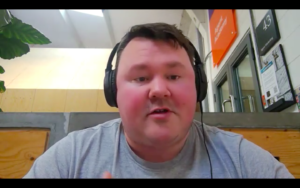
We had a chat last year when I asked you to do this feature – only took me a year to get it sorted. But you said…
DH: Took me about 18 months to start the newsletter. [Laughing] Don’t worry, I know exactly how it feels.
You said at the time that you reckon probably 80% of your work comes from LinkedIn. Is that still the case?
DH: Yeah, it’s probably about the same. Yeah. I get nothing off Twitter, really. Twitter’s just my creative mates. And I don’t do any other marketing. Just LinkedIn. The rest of it is probably just word of mouth or reputation. I’m getting quite popular. Which is weird, it’ll never not feel not that. But I am becoming kind of the go to person for that silly funny daft copy. But yeah, LinkedIn is massive. It always has been since I started doing the funny posts. And that was just a response to the boring stuff which LinkedIn has always been notorious for. It’s been a well of leads and clients and I’d have been lost without it. There was one post in particular I did, I got like 300 enquiries off the back of it. And in my mind I was just like, ‘How can I replicate this? How am I going to handle it all? It was nuts, it brought in so much work at the time, but also lit that spark to kind of do more and just keep doing this stuff because it’s working.
With that in mind then. How do you manage your life on LinkedIn, given the amount of interactions that your stuff generates?
DH: It’s hard. It’s harder when I’ve got a kind of project and I’ve got to box off six hours to get my head into tone of voice or whatever. Because it’s so, as you’ll know, so tempting to have a little bit of down time. If I’m an hour into a project and it’s not happening, I’ll always jump on to something else. Even back when I was taking my exams, if I was stuck on a question I’d plough on to the next one and come back to it later. And I’ve always been that way with work. I’ll work on something ‘till my mind is empty and then I’ll jump on to something else. And social media has always been the something else. As for keeping up with it all, I can’t. I can’t do it all. So I just do as much as I can. A little short “ah, nice one cheers for that” or even a little emoji. I don’t need to get into big debates. A lot of the stuff I do on LinkedIn, it’s just to set a little fire to let all the boring people argue amongst themselves. And then occasionally I’ll chip in with a little witty, jokey retort. Mainly to let anyone that’s interested in hiring me know that I’m on the ball. But yeah, the management is mad. A couple of months ago, I did ‘Angela Harlands Email Takeover’ for my Friday email. I said that I’d left my laptop at my mum’s in the morning and she subsequently went on to write my Friday email and manage my LinkedIn for the day. And I did it as a q&a. I didn’t have any client work that day, so I responded to about 600 comments as my mum and it was all to get the character spot on. I don’t know if you saw it, but to get my mum’s character, I typed everything in capital letters, as if she’s technophobe who doesn’t know how to turn caps lock off. I know that my dad does that. My mum’s a bit more tech savvy so I’ve probably done my her a disservice but my dad’s exactly like that. Even handwriting. It’s always been in capital letters. When he texts, you know, one finger at a time, the classic mum or dad way. And yeah, just responding to everybody it was so hard to keep up. I was having to look back, like refresh probably once an hour, refresh the replies and have a look, refresh the comments and see which ones I hadn’t commented on and then just think of something on the spot. But at the end of it, I had a few people message me and enquire based on the way I’d done it.
You’ve recently written for major household brand names: On The Beach. Tesco. Jaguar. Are all those leads from LinkedIn?
DH: On The Beach contacted me directly and that was through LinkedIn. Their marketing guy, Steve, he’s a scouser and saw me doing whatever I did and it just felt really familiar to him. It’s all about normal, real, everyday people going on holidays rather than you know your Thomas Cooks and whatever where it’s all handwritten names in the sand. This is more about running bombs into the pool and getting getting your 7am airport bevvy and so they saw that I was ideal for them. That was probably the biggest from LinkedIn in terms of company size, revenue size, and them being an everyday brand name. I get quite a lot of tech brands approaching me. They always want to seem less techie or less boring.
What did you want to be when you grew up?
DH: A fireman. Because one of my uncles was a fireman. Uncle Charlie. But once I got to school and knew that I was decent at English and loved writing, I wanted to be a journalist. When I was 15, I did my work experience at the local newspaper. I did English at A level, then I did a journalism degree at uni. So that was where I really kind of learned how to write. It was quite vocational, that course. Like two hour a day of actual writing practice. Learning to do research, to interview. I went to uni in 2000 so Google was probably only like, you know, a year old. Certainly no iPhones or anything. So it was all the old school skills and I’m kind of glad looking back.
Thanks Dave. You really are The Business.
Sign up for Dave’s amazing newsletter
Wanna hire him, visit his website
This interview was produced and written by me, Ben McKinney, a freelance business copywriter from Norwich, Norfolk. You can find our more About Me by clicking here. Or visit my Blog for more interesting and insightful interviews with influential business owners (try saying that 5 times fast) and to read my other recent articles.


