


Hello and welcome to The Business, the interview series where I talk to influential business owners I admire and try to find out what success means to them.
This month my guest is Sophie Cross.
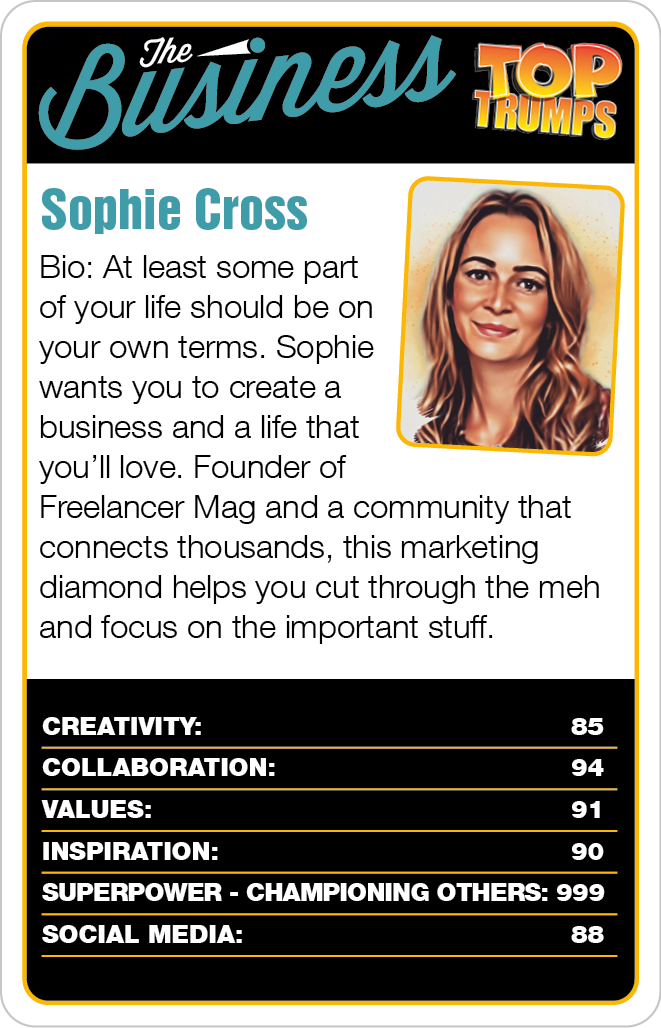
Sophie is a marketer from London, England. During a few short mid-pandemic months in early 2021, she changed the working landscape for freelancers across the world by creating Freelancer Magazine. A crowd-funded, independent print magazine especially for freelancers and small business owners, Freelancer Magazine has subscribers in more than 20 countries and a vibrant and supportive community of readers and contributors around the world.
Sophie also creates marketing and mindset courses for ambitious freelancers and creatives, and produces two fortnightly newsletters – The Dunker, a business and creativity newsletter with tools, tips and inspiration especially for freelancers, and Make It Monday, which bangs the drum for freelancers who make their own stuff.
We spoke on Zoom on the first anniversary of Freelancer Magazine hitting its Kickstarter funding target and talked about:
- How the freelance community was the catalyst for the mag
- Why setting goals in line with your values creates intention and a business that you love
- Why she’s not earned a penny from the magazine so far
But I started by asking her, as I do with all my guests, how do you describe your job when people ask what you do for a living?
Sophie Cross: Well, if you’d asked me a few weeks ago before lots of business coaching, I would have gone, ‘Oh, well, you know, I just kind of make a magazine’ (laughs). I feel cringe saying it, and I shouldn’t say that, but I updated my LinkedIn profile today to Editor and Founder of Freelancer Magazine. Just because I’m trying to see myself in that light a bit more.
How old were you when you first started your own business?
SC: So, I’ve been freelancing for nine years. I was 29.
And how different is your business now from when you first started working for yourself?
SC: I mean, completely different. I still do freelance. But I’m in year one of a start-up. It’s really exciting, you know, it’s everything that I’ve ever wanted. It’s like starting again, to some extent, because the nature of the business is so different. I have loads more costs. I saw Joe Glover say that his first year of The Marketing Meetup he was just shy, scared, uncertain. And I was a bit like, ‘Oh, thank god!’ I suppose freelancing sort of got to the point for me where I was plateauing and I didn’t find it that difficult any more. I was confident if clients came to me that I could do a good job, but I was ready to make changes to my freelance business when the magazine came along.
Knowing what you know now, what would you do differently? Was there anything that you could take from those early experiences into founding Freelancer Magazine?
SC: It all feels like it’s happened very organically. I always had this itch that I would have my own thing and I wanted that thing to be a business. And then when that business was freelancing, that was great. But then I kind of got that itch back again to have a brand or product that I ran that didn’t involve clients. I suppose I just sort of waited for that to happen. And what I’m realising now is there are things you can do to speed that process up. I just didn’t do them. And I don’t know if I regret that particularly. I suppose my learning would be that you know, if you do want these things, if you do want to set up a business, to be a content creator, to grow an audience, to grow a business you love, that there are things you can do. Maybe I could have hustled more [laughs], you know, probably could have cracked on a bit sooner with some things.
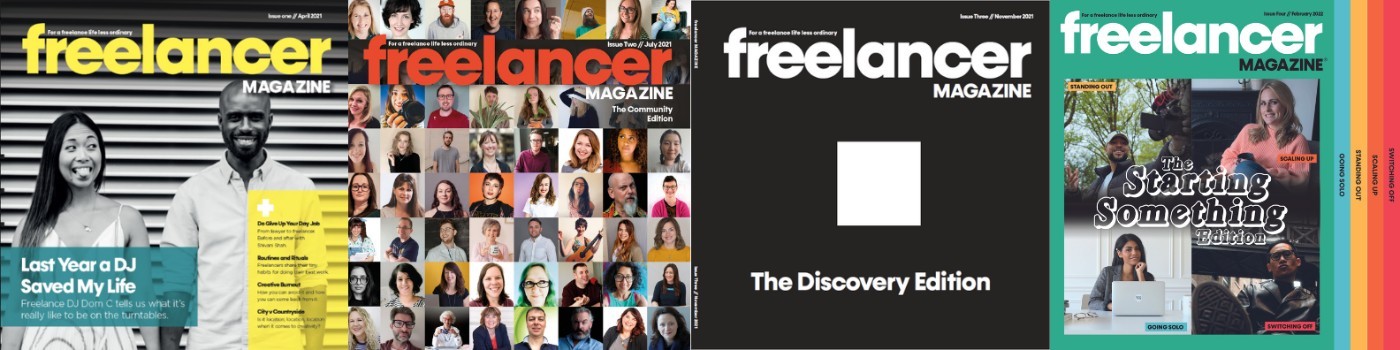
Freelancer magazine covers 1 to 4
Tell me about putting the mag together then. From having the idea to actually publishing the first edition of the magazine was only a few months. How did it all come together so quickly?
SC: I had the idea on New Year’s Day, 2021. The Kickstarter launched at the end of February and ended on the first of April. I really wanted the mag to land in April and I think the first people got it on April 28th. So it was basically exactly four months. And I suppose that’s the kind of thing I was alluding to before; you can speed up if you have the idea and you have the vision. It massively helped that I was already part of freelance communities – that was everything. The idea came from those communities. For anyone wanting to come up with an idea, what I would do now is think about who I wanted to serve, join those communities for a couple of years and just listen and add value and do everything that people tell you to do. Listen to the questions people are asking. I felt that because I’d lost a lot of client work to the pandemic, and because I’d set up the courses, I was really tuning into those things. If I hadn’t been part of freelance communities, I would have had to have quite a lot of money behind me.
Talk me through the decisions that you made in terms of getting into Kickstarter. Obviously you used it to raise the cash, but was it also to validate the idea in some way?
SC: Yeah, absolutely. And the strange thing is, I was never really thinking about Kickstarter in terms of the cash. I think because that’s a given, you know, so I was never sort of thinking, ‘Oh, I need the money up front.’ What I was thinking is ‘I want to know that people want it before I make it.’ Because I’ve made the mistake quite a few times before, setting things up that just didn’t really have a minimum viable product or not thinking about cashflow, because I’m so gung-ho in lots of ways. So yeah, I was just thinking ‘I wanna know people want it’ but also I knew that getting people involved as early as possible was going to get their buy-in. There was no point keeping it a secret. I think that’s one mistake that a lot of business owners, or people just about to set something up, make because that [the early stage] is a really helpful time to get feedback and to get people’s buy-in. I really liked the sense of urgency that Kickstarter created, but then obviously you have to raise the amount you’re after. It was really hard to decide what that amount was. And in hindsight, well, I literally just wouldn’t have been able to set this up if it wasn’t for the money up front, basically. I had such a good experience with it. I mean, apart from nearly burning myself into the ground by being on Twitter all day every day but yeah, it was brilliant. People who have done it said to me before, “Oh my god, you’re doing a Kickstarter? It’s amazing. But you can’t describe the intensity of it.” I get that.
How did you work out what money you needed from the Kickstarter in order to fund the magazine?
SC: I guess it came down to what I was gonna charge for the magazine. It’s really hard to make money from print and publishing. Not having bought tonnes of magazines over the last few years, can I charge £12 for an individual copy? But it came down to the fact I wanted it to be really good. You know, I didn’t want for it to be a 20 page pamphlet. I’d rather people paid more for it and got a really good resource, like, ‘If you’re not getting £12 worth of value out of that magazine, I’ll give you the money back myself” sort of thing. So the first hurdle really was, ‘How much can I charge?’ And then the way I deal with cashflow and planning is really ‘worst case scenario’. It was hard to work out the Kickstarter because there were lots of different ways that we could’ve reached the target. For instance, you could just buy issue one in the Kickstarter. So in theory everyone could have just bought issue one, but I was committed to making issues one to four. And in terms of quantities, the more you print, your costs are going to come down. There were loads of different variables. So I decided to go back to, what is the worst case scenario here? I suppose the week before the Kickstarter went live, I was probably on about £6,000. And then I was like, ‘No, maybe I should make it £8,000’. And then I set it £12,750 and we actually ended up on £18000. And now, looking at the cashflow for the last year, I would be in serious trouble if we didn’t have that money because what do you know, everything takes longer, everything costs more and I’ve been investing quite a bit back into the business. Full disclosure, I haven’t paid myself through the magazine yet.
I was going to ask you about that. Is it a goal further down the line to be paid from it?
SC: Definitely. I suppose if I hadn’t invested in other things, I could have paid myself, and this is one of the most difficult things I feel… God I’m being really honest here. So I suppose one of the most difficult things I find to deal with is your perception of other people’s perception of you. That people might be thinking, “She’s rolling in it,” you know, stuff like that. But then it’s all so relative, isn’t it? I feel I’m building something that has a long term future that I want to work on for a long time. It was never about making a quick buck, it is about growing a really amazing community and it’s about having those foundations in place. Also all of our sales are direct. We have a few retailers but we have a recurring payment model and it’s scalable, right? We print and sell about 1000 magazines a quarter at the moment, but that number is going up and I suppose that if we were doing 2000 then the business would look quite different. That’s obviously an enormous jump but I think ‘Well if I can get to 1000, I can get to 2000’, and I guess it does feel a little bit of a race against time – you know that kind of battle between ‘Enjoy it, keep it fun,’ and, “Fuck! How long until I can pay myself?!” That’s the reality of it, I guess.
You’ve achieved your initial goal of publishing the first four issues. How difficult is it to keep up that level of motivation and drive moving on from one set of goals and establishing new ones?
SC: It’s weird. I feel weirdly calm at the moment about everything. Like I change things the whole time, right, and I had a little bit of a wake up call in the last couple of weeks. My social content is really everything to how we sell magazines. And I realised that I probably wasn’t being intentional with it and that that identity was getting lost and I was starting to post for the sake of it. We’ve also had to make a lot of changes cashflow wise as well going into kind of year two, but things feel weirdly calm at this point in time.
Talking about Social Media, my problem with social media is that I feel really egotistical when I post regularly – even if it’s in line with a goal I might have for my business. You just mentioned posting for a reason, tell me a bit more about that.
SC: I suppose the way I see it is; say you’re a freelancer and you set up a newsletter. You’re so nervous about that newsletter going out – this is how I feel anyway – the fact that anyone subscribes to it, the fact that anyone opens it, the fact that anyone shares it or might reply and say “Hey, I liked that it was really useful”, is just amazing! But then you can get lost, because that feels like success to you – and it is success – but if the intention for that newsletter in the first place was to get more clients and that isn’t what it’s achieving then… I think a lot of people end up stopping their newsletters because they don’t maybe go back and review. Is this still fulfilling the purpose that I wanted it to or have I got distracted? I’m definitely guilty of it. Compared to two years ago, my Twitter and my LinkedIn get notifications the whole time. And I realised I was kind of measuring that as success. And you know, it’s that kind of thing where, would you rather get 100 new followers or get one new client? Would you rather get 100 likes or five people sign up to your newsletter? So it is about being intentional. But that doesn’t just mean sending more sales messages. Just because you want more people to buy a magazine or more people to subscribe to your newsletter, it doesn’t mean ‘okay, I need to do more posts that just say “subscribe to my newsletter.”’ It means thinking about that content being intentional for the purpose. I think what helps me is role models. And this is what I’ve been working on this week, I’ve been doing some courses by different people and thinking, when they tweet, or when they share content, do you feel that they’re being egotistical? If you look at Eddie Shleyner or I don’t know, I look up to a woman called Amanda, oh god I don’t want to get her surname wrong, but her handle is AmandaNat [Amanda Natividad]. She works in marketing for Spark Toro. You know, these people that I really respect, I don’t ever see their content and think ‘Oh, they’re being egotistical’, but they are being intentional.


Can I go back to pre Freelancer Magazine days when you stopped doing client work and decided to offer your marketing courses. What made you completely change tack? Were you just ready for a change or was that decision forced by the pandemic?
SC: A bit of both. I lost a lot of client work. It just kind of dried up because I was working a lot in travel and hospitality. And I suppose there was the freedom of having a blank canvas. So that and realising you don’t have anything to lose, you might as well go in a direction you really want to go in. And if I’m totally honest, I felt that I was getting involved in a race to the bottom and I was frustrated with myself. I started chasing after clients and charging really low prices and I was at a period where I’d moved back to London in February 2020 with my husband and we were both really determined to take our careers to the next level. I had been having this really nice time writing in Exmoor and taking the dog for long walks and going sea swimming every day. But I just wanted something else. So I’d come back to London with this mindset of right, I’m going to take it by storm, I’m going to take my career to the next level. And then to lose client work and to have this weird internal battle of losing confidence, while also sort of believing that you’re better than this. And then charging so little and people saying “oh actually we’ve just gone with someone else because they charged a bit less,” I was just like, ‘Oh man, I can’t deal with this’. I felt that I had to strip everything back and start again. So that’s why I set up the courses. I think it would have either been completely remodelling the clients I targeted and the way I worked with them, that would have been the other option because I was just getting so frustrated with myself and feeling – there was something where I suddenly felt I’m old enough to know better, really. Old enough to feel I had enough experience and that I should be doing myself justice.
When you were little, what did you want to be when you grew up?
SC: I think, a farmer. (Laughs)
Didn’t expect you to say that.
SC: Oh my god. Yeah. I only just thought of that. It just popped into my head. I don’t know if you remember the Sophie’s Snail books? I think they were by Dick King Smith.
I remember him from school.
SC: I was an only child until I was 10 and I related to this Sophie’s Snail book. She would potter around the garden and all her mates were animals and I used to do that. I used to have my bug bottle and tipex the snail shells. All kids did, right?! Write little names on them because they were my friends. Yeah, and make little mini gardens. Even still. We went travelling to India before we moved to Somerset and I have drawings that I did in India of the farm that I was gonna set up. Even now I’m like, oh, it’d be nice to have the goat and the chickens. Yeah, a farmer.
I almost didn’t ask that but I’m glad I did. Alright, last last question: what does success look like for you and how has that changed over time?
SC: This sounds like such a cliche answer but I do believe that it’s having strong values and aligning your work with them. I guess, because I was in a corporate role up until I went freelance, I kind of look at how my life could have been. And I do feel that my work is really aligned to my values now. I’m really proud to be running a business and sticking to how I believe it should be run. And I was thinking this today, it’s actually kind of harder. You know, why would you not set up a business and have a community as part of it? It’s in our nature, right? It’s almost harder to do it the other way around. I guess also I can’t help thinking about monetary success as well. From a business perspective. It’s certainly not top of my priority list, but your business isn’t successful unless you’re making money as well, right? Being able to pay myself would be a success!
Thank you, Sophie. You really are The Business.

Links to Sophie:
Ben’s previous blog: A Story About Imposter Syndrome And How To Beat It


